The figure published for a slot machine is a return to player, which is the complement of the house percentage. A machine described as returning ninety-four per cent has a house percentage of six.
The number is a property of the machine's own table of outcomes, computed over the whole cycle of possible results rather than measured on a floor. It is exact in the same way that the roulette figure is exact, and it is just as silent about any particular session.
Two features of modern machines make the figure harder to read than it looks. The first is that outcomes are drawn continuously by a random number generator and mapped onto the reels, so the visible symbols are a presentation layer rather than the mechanism. The second is that the same machine model is frequently manufactured in several configurations with different returns, and the one installed is chosen by the operator.
So the published return describes a configuration, not a cabinet, and never a particular spin. That is the whole of what the number claims.
A moving number is often read as new information about a game. Sometimes it is. More often it is information about where the money went, and those two things are not the same.
A book moves a number to change the flow of wagers, not to publish a forecast. If one side has drawn the weight of the stakes, the price on that side gets worse until the other side becomes attractive enough to balance it. The size of the move tells you about the imbalance; it tells you nothing on its own about which side was correct.
The confusion is compounded by the fact that both kinds of movement look identical on a screen. A number that moves on a genuine injury and a number that moves because a great many small wagers landed on a popular team produce the same little arrow.
The honest reading of a moved line is therefore narrow: something changed the balance of the book. The interesting question, which the arrow does not answer, is what.
Rather than repeat the conversion arithmetic in every entry, the common prices are set out on one page here, with the implied probability alongside each so the margin in any two-way market can be read off directly.
Blackjack is unusual among casino games in that the player makes decisions that change the arithmetic. What is called basic strategy is simply the complete list of the best decision for every combination of player hand and dealer upcard, under a stated set of rules.
It was not intuition. It was computed, first by hand in the nineteen fifties by four mathematicians working with mechanical calculators, and later far more thoroughly by computer. The result is a grid, and the grid changes when the rules change: the number of decks, whether the dealer draws on a soft seventeen, whether doubling after splitting is allowed.
The point of the grid is not that it produces a winning game. Followed exactly, under favourable rules, it reduces the house percentage to a fraction of one per cent, which is a small number and is still a number on the house's side.
What it does illustrate is that a house percentage is a property of rules plus play. In every other game on this list the player has no dial to turn. Here there is one, and it is a lookup table.
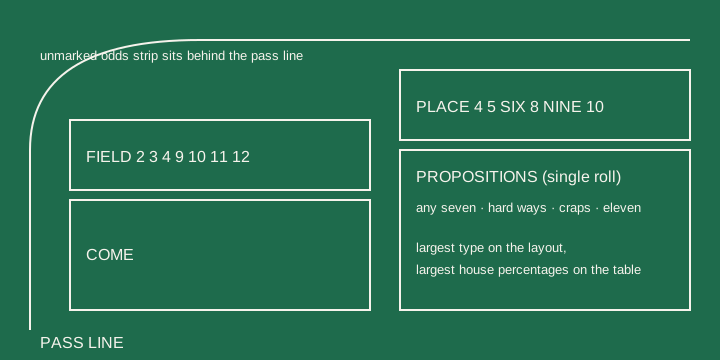
One half of a craps layout. The two ends are mirror images; the centre is shared.
Reading a Craps Table Layout
A craps layout looks crowded because it is two identical betting areas printed at either end of the table with a shared area of proposition bets in the middle. Learning one end is learning the whole table.
The long band running around the outside is the pass line. Inside it sit the come area, the field with its own printed payouts, and the boxes for the place numbers, four, five, six, eight, nine and ten. Behind the pass line is an unmarked strip where the odds wager is placed, and it is unmarked precisely because it is the one wager on the table carrying no house percentage at all.
The centre of the table holds the single-roll propositions, printed in the largest type and carrying by a distance the largest house percentages on the layout. The inverse relationship between the size of the printing and the fairness of the price is not an accident of design.
Read from the outside in, the layout is a gradient. The quietest markings are the cheapest wagers.
Legal sports betting in the United States spent most of the twentieth century in a single state, and even there it spent decades as a business the casinos did not want in their buildings.
Nevada licensed bookmaking in the nineteen forties, but a federal excise tax on wagers made the margins hopeless, and the trade lived in independent rooms known as turf clubs, separate from the casino floor. When the tax was cut sharply in the middle seventies the arithmetic changed, and the books moved indoors.
What followed was an architectural shift as much as a commercial one. The wall of boards, the tiered seating, the screens for every game at once: those are artefacts of a business that suddenly had to be worth walking into and staying in.
The federal statute that froze the map elsewhere arrived in nineteen ninety-two, and was struck down by the Supreme Court in twenty eighteen, after which individual states began legislating for themselves. The oldest continuous practice, though, is the one in the room with the boards.
A parlay joins several selections into one wager that requires all of them. The appeal is the payout, which grows quickly, and the difficulty is that the probability shrinks just as quickly.
Take three selections each priced at minus one ten, each implying a shade over fifty-two per cent. Multiplied together they imply a little under fourteen and a half per cent. A fair price for that combination would be near six to one. The common fixed payout for a three-team parlay is six to one on the nose, which sits below fair by enough to make the combined margin considerably larger than the margin on any one of the three prices.
That is the general shape. Combining wagers does not combine the margins gently; it compounds them. A book that takes four and a half per cent on a single price takes a good deal more than three times that on a three-part ticket.
None of which makes the parlay an unusual product. It is simply priced as an entertainment with a long shape, and its arithmetic is worth reading before rather than after.
Two percentages get quoted about a casino game and they measure different things. House edge is the share of each wager the house expects to keep. Hold is the share of the money brought to the table that the house ends up with.
Hold is always the larger figure, and often by a great deal, because a player does not bring one stake and leave. The same chips are wagered again and again, and each pass through the game is exposed to the edge afresh. A game with a house percentage close to one per cent can still show a table hold many times that number, without anything unusual happening.
This is why comparing a published edge with a published hold and concluding that something is wrong is a category error. One is a property of the rules; the other is a property of the rules and how long people play under them.
The practical consequence runs the other way from intuition. Time at the table, not the size of any single wager, is what converts a small percentage into a visible amount.
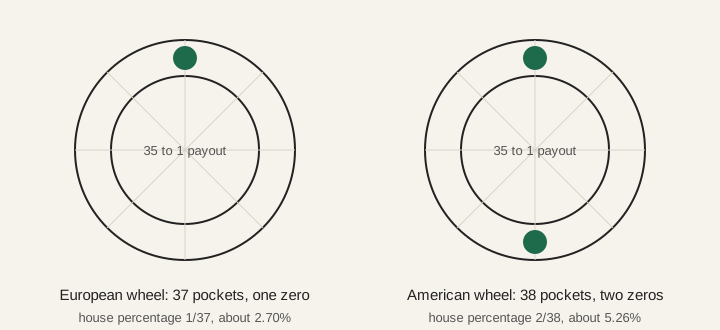
Thirty-seven pockets against thirty-eight: the entire difference between the two games.
Why an American Wheel Carries Two Zeros
The two wheels look alike and are not. A European wheel has thirty-seven pockets, the numbers one to thirty-six and a single zero. An American wheel has thirty-eight, because a double zero was added.
Every straight-up number still pays thirty-five to one on both wheels. That payout would be exactly fair on a wheel of thirty-six pockets. On thirty-seven the shortfall is one part in thirty-seven, a little over two and a half per cent. On thirty-eight it is two parts in thirty-eight, a little over five and a quarter per cent. Adding one pocket without changing the payout roughly doubled the house percentage.
The history is the reverse of what most people assume. The single zero came second, introduced in the middle of the nineteenth century by operators competing for players who could choose where to play. The double-zero form is the older survival, carried to American rooms and kept there.
Nothing about the physical wheel enforces this. It is a payout convention meeting a pocket count, and the drawing above contains the whole argument.
A point spread is a handicap expressed in the units of the sport. Giving six and a half points to one side means the result is settled by the margin of victory rather than by the winner, and the half point exists so that the margin can never land exactly on the number.
Opening numbers come out of the book's own estimate of the game, often circulated to a small audience first so that the sharpest early opinions can be absorbed before the wider public sees a price. From that point the number is managed rather than recalculated. Money arriving on one side moves it; the book is looking for a figure that draws roughly equal interest.
Certain numbers move slowly and reluctantly. In American football, margins of three and seven occur far more often than their neighbours because of the scoring system itself, so a book will usually adjust the price attached to a spread of three before it will move the spread through three.
The distinction between the handicap and the price attached to it is the whole of the craft. A book has two dials and prefers to turn the quieter one.
Three notations describe the same thing, and each was shaped by the place that used it. American odds are written against a hundred: minus one fifty means a hundred and fifty risked to win a hundred, plus one fifty means a hundred risked to win a hundred and fifty. The hundred is a unit of account, not an instruction about stake size.
Decimal odds, the continental form, quote the total return per unit staked, so a price of two and a half returns two and a half units in all, of which one and a half is profit. Fractional odds, the British racecourse form, quote profit against stake, so the same price is written three to two.
Converting between them is arithmetic, not judgement. A decimal price is one plus the fraction. An American minus price divided by itself plus a hundred gives the implied probability; an American plus price is a hundred divided by the price plus a hundred. A price of minus one fifty implies sixty per cent; a price of plus one fifty implies forty per cent.
Add the implied probabilities on both sides of a two-way market and the total exceeds one hundred per cent. The excess is the margin described in the entry on the vigorish. It is the reason a set of prices is never a set of forecasts.
A sports book that prices both sides of a game at minus one hundred and ten is not charging a fee at the door. It is charging inside the price. Each side risks eleven to win ten, and the extra dollar is the whole of the book's business.
The arithmetic is easy to follow if the two sides are imagined as equal. Two bettors each put up eleven dollars. Twenty-two dollars sits on the table. One of them collects twenty-one, and the book keeps one. One dollar out of twenty-two is a little over four and a half per cent of everything staked, which is the number that matters to the book and the number almost nobody quotes.
That figure is not the same as the number a bettor loses on average, and it is not the book's profit either, because the two sides are almost never exactly equal. It is simply the margin built into a balanced pair of prices. Everything else a book does is an attempt to move the real money closer to that balanced state.
The word itself is a borrowing. Vigorish came into American usage from a Yiddish rendering of a Russian word for winnings, and by the middle of the twentieth century it meant the cut taken by whoever was holding the money. It survives in sports betting long after the rooms that coined it closed.